R&D Tax Allowance: 24.5% Back on Contract AI Development
German SMEs that commission external AI/software R&D can reclaim ~24.5% of the invoice via the Forschungszulage — a legal entitlement, retroactive, uncapped.
The quiet discount hiding in your development budget
Most German SMEs treat external AI development as a pure cost. Few realise the state already co-finances a meaningful slice of it. The instrument is the Forschungszulage — Germany's research allowance — and the mechanism that makes it work for commissioned work is called Auftragsforschung (contract research).
The logic is simple. When you commission a contractor to carry out a research-and-development project, 70 % of the remuneration you pay counts as eligible expenditure (§ 3 Abs. 4 FZulG, for contracts placed after 27 March 2024; it was 60 % before). On that basis you receive the research allowance: 25 % as a standard rate, 35 % for SMEs (§ 4 FZulG). The net effect on the contractor's invoice:
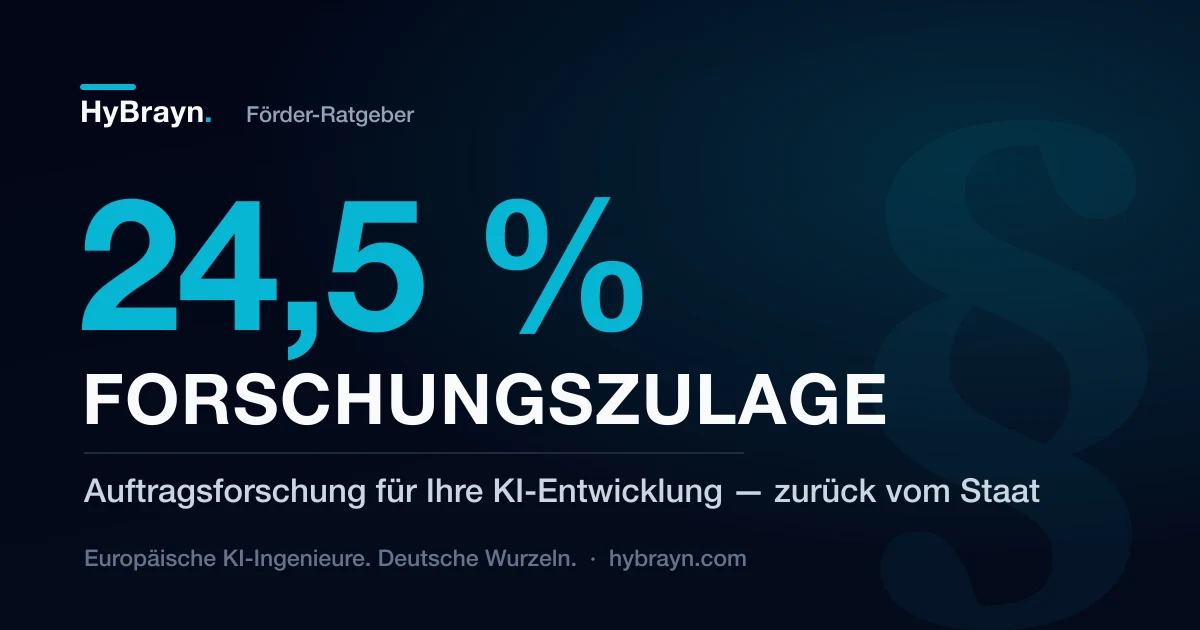
70 % × 35 % = 24.5 % for an SME client — and 17.5 % for a large company.
On a €50,000 development project that is €12,250 back; on €100,000 it is €24,500. The contractor still invoices in full — this lowers your effective cost, financed by the state, not by a discount.
Why this is an entitlement, not a grant lottery
This is the part that surprises most decision-makers. The Forschungszulage is not one of the regional digitalisation grants where a monthly quota sells out at 10 a.m. or a lottery decides who may even apply. It is a legal entitlement (Rechtsanspruch). If the project qualifies and is certified, you receive it — there is no budget cap and no competition.
Two more properties make it unusually practical:
- Retroactive. Unlike classic grants, there is no "apply before you start" trap. You can claim for projects already running or completed, within the four-year assessment period.
- No application deadline for the certification. The R&D certificate from the Bescheinigungsstelle (BSFZ) can be applied for at any time.
In other words: the project does not wait for the funding, and the funding does not run out.
The one condition that decides everything: technical uncertainty
Here is where honesty matters more than enthusiasm. Not every development project qualifies. The decisive test, oriented on the OECD Frascati Manual, asks whether the work meets three cumulative criteria: novelty, technical uncertainty, and a systematic approach.
The criterion that carries the most weight — and where most weak applications fail — is technical uncertainty. At the start of the project, was it genuinely unclear whether the goal could be reached at the required quality, and why? If an experienced specialist could have predicted the outcome and the path using existing knowledge, it is routine, not research.
In practice:
- Qualifies: developing a novel method, model, or architecture where the technical feasibility was genuinely open — for example, achieving zero hallucinations on legally critical outputs from heterogeneous source data.
- Does not qualify: wiring an existing language-model API into a standard workflow, or deploying off-the-shelf retrieval.
Who claims what: the EU-contractor structure
The roles are fixed by law, and getting them right is what makes the model robust:
- The German company is the applicant (§ 1 FZulG). The contractor never claims it.
- The contractor must have its management seat in an EU or EWR state (§ 2 Abs. 5 FZulG). A European development partner — for example a company based in another EU member state — qualifies on the same footing as a German one.
- The claim runs in two stages: first the technical R&D certificate from the BSFZ, then the allowance itself, claimed by your tax advisor with the annual tax return.
This is precisely why a European engineering partner such as HyBrayn fits the structure cleanly: we are the eligible contractor, you are the applicant, and your tax advisor handles the filing.
How HyBrayn guides you through this process — from the preliminary check to the filing — is outlined in our funding service for AI projects.
The honesty conditions most pitches skip
If a funding consultant promises "free money" with no conditions, be sceptical. Three points decide whether the construction holds:
- The client must own the result. Following the German Federal Ministry of Finance guidance (BMF letter of 7 Feb 2023, margin no. 49), contract research requires that you set the goal, bear the risk of failure, and either acquire the IP or receive an exclusive, paid licence to the new rights. A pure "product off the shelf" purchase does not qualify — and the same solution cannot be resold to many clients and funded each time.
- It is a tax matter, not a grant. The money offsets your tax liability after the fiscal year; it is not paid out before the project.
- No guarantees, no tax advice. Whether your specific project qualifies is a case-by-case judgement, and the filing belongs with your tax advisor.
What this means for your next AI project
For German SMEs, the practical takeaway is straightforward: if your next AI or software project carries real technical uncertainty, a large share of the development cost can come back through the Forschungszulage — reliably, retroactively, and without a budget race. The work that matters is framing the technical uncertainty correctly, which is exactly what a competent engineering partner can document.
Start with a free R&D pre-check. We assess in a short conversation whether your project qualifies as contract research and what the realistic funding picture looks like — before any effort is spent. Book a free Förder-Check.
Disclaimer: This article is general information, not tax or legal advice. Eligibility depends on the individual case; the allowance is assessed by the tax office and filed by your tax advisor. No guarantee of approval.
Frequently Asked Questions
Can a German company really get money back for hiring an external AI developer?
Yes — through Auftragsforschung (contract research) under the Forschungszulage. If the project involves genuine technical uncertainty, 70 % of the contractor's invoice counts as eligible expenditure (§ 3 Abs. 4 FZulG). At the SME rate of 35 % that is effectively ~24.5 % of the invoice back. The German company is the applicant; the contractor only needs to be based in the EU/EWR (§ 2 Abs. 5 FZulG). This is not tax advice — the claim is filed by your tax advisor.
Does our project qualify?
Only if it has genuine technical uncertainty in the sense of the OECD Frascati Manual — novelty, an open technical outcome, and a systematic approach. Routine integration of established tools (a standard API, off-the-shelf RAG) does not qualify. Whether a specific project qualifies is decided case by case; a short pre-check clarifies it before any effort is spent.
Is the funding guaranteed, and when does the money arrive?
The Forschungszulage is a legal entitlement (Rechtsanspruch), not a competitive grant — no budget cap, no lottery. But it is not automatic: the project must be certified as R&D by the Bescheinigungsstelle (BSFZ), and your tax advisor claims it with the annual tax return, so the money offsets tax after the fiscal year. There is no guarantee of approval, and this article is not tax or legal advice.